La noche oscura


   Canciones del alma que se goza de haber llegado al
   alto estado de la perfección, que es la unión con Dios,
   por el camino de la negación espiritual.


 En una noche oscura,
con ansias en amores inflamada,
(¡oh dichosa ventura!)
salí sin ser notada,
estando ya mi casa sosegada.                     5

 A oscuras y segura,
por la secreta escala disfrazada,
(¡oh dichosa ventura!)
a oscuras y en celada,
estando ya mi casa sosegada.                     10

 En la noche dichosa,
en secreto, que nadie me veía,
ni yo miraba cosa,
sin otra luz ni guía
sino la que en el corazón ardía.                 15

 Aquésta me guïaba
más cierta que la luz del mediodía,
adonde me esperaba
quien yo bien me sabía,
en parte donde nadie parecía.                    20

 ¡Oh noche que me guiaste!,
¡oh noche amable más que el alborada!,
¡oh noche que juntaste
amado con amada,
amada en el amado transformada!                  25

 En mi pecho florido,
que entero para él solo se guardaba,
allí quedó dormido,
y yo le regalaba,
y el ventalle de cedros aire daba.               30

 El aire de la almena,
cuando yo sus cabellos esparcía,
con su mano serena
en mi cuello hería,
y todos mis sentidos suspendía.                  35

 Quedéme y olvidéme,
el rostro recliné sobre el amado,
cesó todo, y dejéme,
dejando mi cuidado
entre las azucenas olvidado.                     40
domingo, 4 de julho de 2010
La noche oscura, San Juan de la Cruz

quinta-feira, 22 de janeiro de 2009
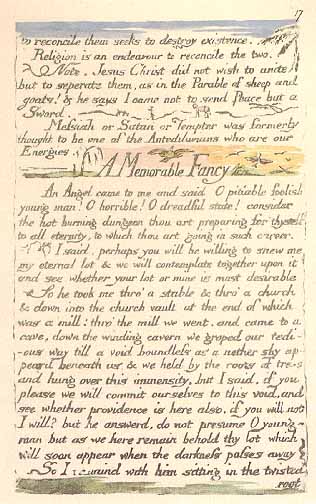
"A Memorable Fancy", Blake (Marriage of Heaven and Hell, Plates 17-20)
A MEMORABLE FANCY
An Angel came to me and said O pitiable foolish young man! O horrible! O dreadful state! consider the hot burning dungeon thou art preparing for thyself to all eternity, to which thou art going in such career.
I said, perhaps you will be willing to shew me my eternal lot & we will contemplate together upon it and see whether your lot or mine is most desirable.
So he took me thro' a stable & thro' a church & down into the church vault at the end of which was a mill: thro' the mill we went, and came to a cave, down the winding cavern we groped our tedious way till a void boundless as a nether sky appear'd beneath us, & we held by the roots of trees and hung over this immensity, but I said, if you please we will commit ourselves to this void, and see whether providence is here also, if you will not, I will? but he answer'd, do not presume O young-man but as we here remain behold thy lot which will soon appear when the darkness passes away.
So I remain'd with him sitting in the twisted root of an oak; he was suspended in a fungus, which hung with the head downward into the deep.
By degrees we beheld the infinite Abyss, fiery as the smoke of a burning city; beneath us at an immense distance was the sun, black but shining; round it were fiery tracks on which revolv'd vast spiders, crawling after their prey; which flew or rather swum in the infinite deep, in the most terrific shapes of animals sprung from corruption, & the air was full of them, & seem'd composed of them; these are Devils, and arc called Powers of the air. I now asked my companion which was my eternal lot? he said, between the black & white spiders.
But now, from between the black & white spiders, a cloud and fire burst and rolled thro' the deep, blackning all beneath, so that the nether deep grew black as a sea & rolled with a terrible noise; beneath us was nothing now to be seen but a black tempest, till looking east between the clouds & the waves, we saw a cataract of blood mixed with fire, and not many stones throw from us appear'd and sunk again the scaly fold of a monstrous serpent; at last to the east, distant about three degrees appear'd a fiery crest above the waves; slowly it reared like a ridge of golden rocks till we discover'd two globes of crimson fire, from which the sea fled away in clouds of smoke, and now we saw, it was the head of Leviathan; his forehead was divided into streaks of green & purple like those on a tygers forehead: soon we saw his mouth & red gills hang just above the raging foam tinging the black deep with beams of blood, advancing toward us with all the fury of a spiritual existence.
My friend the Angel climb'd up from his station into the mill; I remain'd alone, & then this appearance was no more, but I found myself sitting on a pleasant bank beside a river by moonlight hearing a harper who sung to the harp, & his theme was, The man who never alters his opinion is like standing water, & breeds reptiles of the mind.
But I arose, and sought for the mill & there I found my Angel, who surprised asked me how I escaped?
I answer'd, All that we saw was owing to your metaphysics; for when you ran away, I found myself on a bank by moonlight hearing a harper. But now we have seen my eternal lot, shall I shew you yours? he laugh'd at my proposal; but I by force suddenly caught him in my arms, & flew westerly thro' the night, till we were elevated above the earths shadow; then I flung myself with him directly into the body of the sun; here I clothed myself in white, & taking in my hand Swedenborgs volumes, sunk from the glorious clime, and passed all the planets till we came to saturn; here I staid to rest, & then leap'd into the void, between saturn & the fixed stars.
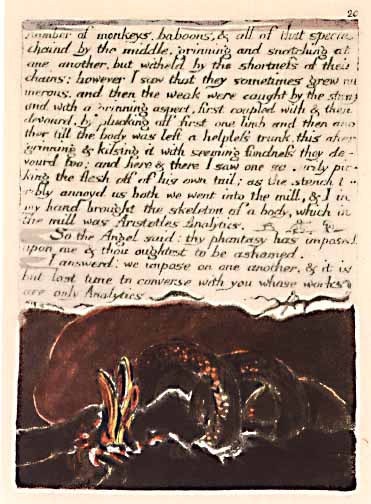
Here, said I! is your lot, in this space, if space it may be call'd. Soon we saw the stable and the church, & I took him to the altar and open'd the Bible, and lo! it was a deep pit, into which I descended driving the Angel before me; soon we saw seven houses of brick; one we enter'd; in it were a number of monkeys, baboons, & all of that species, chain'd by the middle, grinning and snatching at one another, but witheld by the shortness of their chains; however I saw that they sometimes grew numerous, and then the weak were caught by the strong, and with a grinning aspect, first coupled with & then devour'd, by plucking off first one limb and then another till the body was left a helpless trunk; this after grinning & kissing it with seeming fondness they devour'd too; and here & there I saw one savourily picking the flesh off of his own tail; as the stench terribly annoy'd us both we went into the mill, & I in my hand brought the skeleton of a body, which in the mill was Aristotles Analytics.
So the Angel said: thy phantasy has imposed upon me & thou oughtest to be ashamed.
I answer'd: we impose on one another, & it is but lost time to converse with you whose works are only Analytics.
quinta-feira, 12 de junho de 2008
...
That I might drink, and leave the world unseen,
And with thee fade away into the forest dim
(Keats, Ode to a nightingale)
And with thee fade away into the forest dim
(Keats, Ode to a nightingale)
Fernando Pessoa, I.
Whether we write or speak or do but look
We are ever unapparent. What we are
Cannot be transfused into word or book,
Our soul from us is infinitely far.
However much we give our thoughts the will
To be our soul and gesture it abroad,
Our hearts are incommunicable still.
In what we show ourselves we are ignored.
The abyss from soul to soul cannot be bridged
By any skill of thought or trick of seeming.
Unto our very selves we are abridged
When we would utter to our thought our being.
We are our dreams of ourselves souls by gleams,
And each to each other dreams of others' dreams.
We are ever unapparent. What we are
Cannot be transfused into word or book,
Our soul from us is infinitely far.
However much we give our thoughts the will
To be our soul and gesture it abroad,
Our hearts are incommunicable still.
In what we show ourselves we are ignored.
The abyss from soul to soul cannot be bridged
By any skill of thought or trick of seeming.
Unto our very selves we are abridged
When we would utter to our thought our being.
We are our dreams of ourselves souls by gleams,
And each to each other dreams of others' dreams.
sábado, 31 de maio de 2008

E. Bronner, NY Times : «U.S. Withdraws Fulbright Grants to Gaza»
U.S. Withdraws Fulbright Grants to Gaza
Published: May 30, 2008
GAZA — The American State Department has withdrawn all Fulbright grants to Palestinian students in Gaza hoping to pursue advanced degrees at American institutions this fall because Israel has not granted them permission to leave.
Israel has isolated this coastal strip, which is run by the militant group Hamas. Given that policy, the United States Consulate in Jerusalem said the grant money had been “redirected” to students elsewhere out of concern that it would go to waste if the Palestinian students were forced to remain in Gaza.
A letter was sent by e-mail to the students on Thursday telling them of the cancellation. Abdulrahman Abdullah, 30, who had been hoping to study for an M.B.A. at one of several American universities on his Fulbright, was in shock when he read it.
“If we are talking about peace and mutual understanding, it means investing in people who will later contribute to Palestinian society,” he said. “I am against Hamas. Their acts and policies are wrong. Israel talks about a Palestinian state. But who will build that state if we can get no training?”
Some Israeli lawmakers, who held a hearing on the issue of student movement out of Gaza on Wednesday, expressed anger that their government was failing to promote educational and civil development in a future Palestine given the hundreds of students who had been offered grants by the United States and other Western governments.
“This could be interpreted as collective punishment,” complained Rabbi Michael Melchior, chairman of the Parliament’s education committee, during the hearing. “This policy is not in keeping with international standards or with the moral standards of Jews, who have been subjected to the deprivation of higher education in the past. Even in war, there are rules.” Rabbi Melchior is from the Meimad Party, allied with Labor.
The committee asked the government and military to reconsider the policy and get back to it within two weeks. But even if the policy is changed, the seven Fulbright grantees in Gaza are out of luck for this year. Their letters urged them to reapply next year.
Israel’s policy appears to be in flux. At the parliamentary hearing on Wednesday, a Defense Ministry official recalled that the cabinet had declared Gaza “hostile territory” and decided that the safety of Israeli soldiers and civilians at or near the border should be risked only to facilitate the movement out of Gaza for humanitarian concerns, like medical treatment. Higher education, he said, was not a humanitarian concern.
But when a query about the canceled Fulbrights was made to the prime minister’s office on Thursday, senior officials expressed surprise. They said they did, in fact, consider study abroad to be a humanitarian necessity and that when cases were appealed to them, they would facilitate them.
They suggested that American officials never brought the Fulbright cases to their attention. The State Department and American officials in Israel refused to discuss the matter. But the failure to persuade the Israelis may have stemmed from longstanding tensions between the consulate in Jerusalem, which handles Palestinian affairs, and the embassy in Tel Aviv, which manages relations with the Israeli government.
The study grants notwithstanding, the Israeli officials argued that the policy of isolating Gaza was working, that Palestinians here were starting to lose faith in Hamas’s ability to rule because of the hardships of life.
Since Hamas, a radical Islamist group that opposes Israel’s existence, carried out what amounted to a coup d’état in Gaza against the more secular Fatah party a year ago, hundreds of rockets and mortar shells have been launched from here at Israeli civilians, truck and car bombs have gone off and numerous attempts to kidnap Israeli soldiers have taken place.
While Hamas says the attacks are in response to Israeli military incursions into Gaza, it also says it will never recognize Israel.
“We are using the rockets to shake the conscience of the world about Israeli aggression,” argued Ahmed Yusef, political adviser to the Hamas foreign minister in an interview in his office here. “All our rockets are a reaction to Israeli aggression.”
The Israeli closing of Gaza has added markedly to the difficulty of daily life here, with long lines for cooking gas and a sense across the population of being under siege. Israel does send in about 70 truckloads per day of wheat, dairy products and medical equipment as well as some fuel, and it permits some medical cases out.
But Israel’s stated goal is to support moderates among the Palestinians so that Hamas will lose power, and even some security-conscious Israeli hard-liners say that the policy of barring students with grants abroad is counterproductive.
“We correctly complain that the Palestinian Authority is not building civil society, but when we don’t help build civil society this plays into the hands of Hamas,” said Natan Sharansky, a former government official. “The Fulbright is administered independently, and people are chosen for it due to their talents.”
The State Department Web site describes the Fulbright, the American government’s flagship program in international educational exchange, as “an integral part of U.S. foreign relations.” It adds, “the Fulbright Program creates a context to provide a better understanding of U.S. views and values, promotes more effective binational cooperation and nurtures open-minded, thoughtful leaders, both in the U.S. and abroad, who can work together to address common concerns.”
Sari Bashi, who directs Gisha, an Israeli organization devoted to monitoring and increasing the free movement of Palestinians, said, “The fact that the U.S. cannot even get taxpayer-funded Fulbright students out of Gaza demonstrates the injustice and short-sightedness of a closure policy that arbitrarily traps 1.5 million people, including hundreds of Palestinian students accepted to universities abroad.” She said that their education was good not just for Palestinian society, but for Israel as well.
Some Israelis disagree strongly.
“We are fighting the regime in Gaza that does its utmost to kill our citizens and destroy our schools and our colleges,” said Yuval Steinitz, a lawmaker from the opposition Likud Party. “So I don’t think we should allow students from Gaza to go anywhere. Gaza is under siege, and rightly so, and it is up to the Gazans to change the regime or its behavior.”
Hadeel Abukwaik, a 23-year-old engineering software instructor in Gaza, had hoped to do graduate work in the United States this fall on the Fulbright that she thought was hers. She had stayed in Gaza this past winter when its metal border fence was destroyed and tens of thousands of Gazans poured into Egypt, including her sister, because the agency administering the Fulbright told her she would get the grant only if she stayed put. She lives alone in Gaza where she was sent to study because the cost is low; her parents, Palestinian refugees, live in Dubai.
“I stayed to get my scholarship,” she said. “Now I am desperate.”
She, like her six colleagues, was in disbelief. Mr. Abdullah, who called the consulate in Jerusalem for further explanation after receiving his letter, said to the official on the other end, “I still cannot believe that the American administration is not able to convince the Israelis to let seven Palestinians out of Gaza.”
terça-feira, 27 de maio de 2008

L. Kaufman, NY Times : «A Superhighway to Bliss»
A Superhighway to Bliss
May 25, 2008JILL BOLTE TAYLOR was a neuroscientist working at Harvard’s brain research center when she experienced nirvana.
Dr. Taylor says the right, creative lobe can be used to foster contentment.
But she did it by having a stroke.
On Dec. 10, 1996, Dr. Taylor, then 37, woke up in her apartment near Boston with a piercing pain behind her eye. A blood vessel in her brain had popped. Within minutes, her left lobe — the source of ego, analysis, judgment and context — began to fail her. Oddly, it felt great.
The incessant chatter that normally filled her mind disappeared. Her everyday worries — about a brother with schizophrenia and her high-powered job — untethered themselves from her and slid away.
Her perceptions changed, too. She could see that the atoms and molecules making up her body blended with the space around her; the whole world and the creatures in it were all part of the same magnificent field of shimmering energy.
“My perception of physical boundaries was no longer limited to where my skin met air,” she has written in her memoir, “My Stroke of Insight,” which was just published by Viking.
After experiencing intense pain, she said, her body disconnected from her mind. “I felt like a genie liberated from its bottle,” she wrote in her book. “The energy of my spirit seemed to flow like a great whale gliding through a sea of silent euphoria.”
While her spirit soared, her body struggled to live. She had a clot the size of a golf ball in her head, and without the use of her left hemisphere she lost basic analytical functions like her ability to speak, to understand numbers or letters, and even, at first, to recognize her mother. A friend took her to the hospital. Surgery and eight years of recovery followed.
Her desire to teach others about nirvana, Dr. Taylor said, strongly motivated her to squeeze her spirit back into her body and to get well.
This story is not typical of stroke victims. Left-brain injuries don’t necessarily lead to blissful enlightenment; people sometimes sink into a helplessly moody state: their emotions run riot. Dr. Taylor was also helped because her left hemisphere was not destroyed, and that probably explains how she was able to recover fully.
Today, she says, she is a new person, one who “can step into the consciousness of my right hemisphere” on command and be “one with all that is.”
To her it is not faith, but science. She brings a deep personal understanding to something she long studied: that the two lobes of the brain have very different personalities. Generally, the left brain gives us context, ego, time, logic. The right brain gives us creativity and empathy. For most English-speakers, the left brain, which processes language, is dominant. Dr. Taylor’s insight is that it doesn’t have to be so.
Her message, that people can choose to live a more peaceful, spiritual life by sidestepping their left brain, has resonated widely.
In February, Dr. Taylor spoke at the Technology, Entertainment, Design conference (known as TED), the annual forum for presenting innovative scientific ideas. The result was electric. After her 18-minute address was posted as a video on TED’s Web site, she become a mini-celebrity. More than two million viewers have watched her talk, and about 20,000 more a day continue to do so. An interview with her was also posted on Oprah Winfrey’s Web site, and she was chosen as one of Time magazine’s 100 most influential people in the world for 2008.
She also receives more than 100 e-mail messages a day from fans. Some are brain scientists, who are fascinated that one of their own has had a stroke and can now come back and translate the experience in terms they can use. Some are stroke victims or their caregivers who want to share their stories and thank her for her openness.
But many reaching out are spiritual seekers, particularly Buddhists and meditation practitioners, who say her experience confirms their belief that there is an attainable state of joy.
“People are so taken with it,” said Sharon Salzberg, a founder of the Insight Mediation Society in Barre, Mass. “I keep getting that video in e-mail. I must have 100 copies.”
She is excited by Dr. Taylor’s speech because it uses the language of science to describe an occurrence that is normally ethereal. Dr. Taylor shows the less mystically inclined, she said, that this experience of deep contentment “is part of the capacity of the human mind.”
Since the stroke, Dr. Taylor has moved to Bloomington, Ind., an hour from where she was raised in Terre Haute and where her mother, Gladys Gillman Taylor, who nursed her back to health, still lives.
Originally, Dr. Taylor became a brain scientist — she has a Ph.D. in life sciences with a specialty in neuroanatomy — because she has a mentally ill brother who suffers from delusions that he is in direct contact with Jesus. And for her old research lab at Harvard, she continues to speak on behalf of the mentally ill.
But otherwise, she has dialed back her once loaded work schedule. Her house is on a leafy cul-de-sac minutes from Indiana University, which she attended as an undergraduate and where she now teaches at the medical school.
Her foyer is painted a vibrant purple. She greets a stranger at the door with a warm hug. When she talks, her pale blue eyes make extended contact.
Never married, she lives with her dog and two cats. She unselfconsciously calls her mother, 82, her best friend.
She seems bemused but not at all put off by the hundreds who have reached out to her on a spiritual level. Religious ecstatics who claim to see angels have asked her to appear on their radio and television programs.
She has declined these offers. Although her father is an Episcopal minister and she was raised in his church, she cannot be counted among the traditionally faithful. “Religion is a story that the left brain tells the right brain,” she said.
Still, Dr. Taylor says, “nirvana exists right now.”
“There is no doubt that it is a beautiful state and that we can get there,” she said.
That belief has certainly sparked debate. On Web sites like evolvingbeings.com and in Eckhart Tolle discussion groups, people debate whether she is truly enlightened or just physically damaged and confused.
Even her own scientific brethren have wondered.
“When I saw her on the TED video, at first I thought, Oh my god, is she losing it,” said Dr. Francine M. Benes, director of the Harvard Brain Tissue Resource Center, where Dr. Taylor once worked.
Dr. Benes makes clear that she still thinks Dr. Taylor is an extraordinary and competent woman. “It is just that the mystical side was not apparent when she was at Harvard,” Dr. Benes said.
Dr. Taylor makes no excuses or apologies, or even explanations. She says instead that she continues to battle her left brain for the better. She gently offers tips on how it might be done.
“As the child of divorced parents and a mentally ill brother, I was angry,” she said. Now when she feels anger rising, she trumps it with a thought of a person or activity that brings her pleasure. No meditation necessary, she says, just the belief that the left brain can be tamed.
Her newfound connection to other living beings means that she is no longer interested in performing experiments on live rat brains, which she did as a researcher.
She is committed to making time for passions — physical and visual — that she believes exercise her right brain, including water-skiing, guitar playing and stained-glass making. A picture of one of her intricate stained-glass pieces — of a brain — graces the cover of her book.
Karen Armstrong, a religious historian who has written several popular books including one on the Buddha, says there are odd parallels between his story and Dr. Taylor’s.
“Like this lady, he was reluctant to return to this world,” she said. “He wanted to luxuriate in the sense of enlightenment.”
But, she said, “the dynamic of the religious required that he go out into the world and share his sense of compassion.”
And in the end, compassion is why Dr. Taylor says she wrote her memoir. She thinks there is much to be mined from her experience on how brain-trauma patients might best recover and, in fact, she hopes to open a center in Indiana to treat such patients based on those principles.
And then there is the question of world peace. No, Dr. Taylor doesn’t know how to attain that, but she does think the right hemisphere could help. Or as she told the TED conference:
“I believe that the more time we spend choosing to run the deep inner peace circuitry of our right hemispheres, the more peace we will project into the world, and the more peaceful our planet will be.”
It almost seems like science.
quarta-feira, 21 de maio de 2008


quinta-feira, 15 de maio de 2008
D. Brooks , NY Times : «The Neural Buddhists»
The Neural Buddhists
In 1996, Tom Wolfe wrote a brilliant essay called “Sorry, but Your Soul Just Died,” in which he captured the militant materialism of some modern scientists.
To these self-confident researchers, the idea that the spirit might exist apart from the body is just ridiculous. Instead, everything arises from atoms. Genes shape temperament. Brain chemicals shape behavior. Assemblies of neurons create consciousness. Free will is an illusion. Human beings are “hard-wired” to do this or that. Religion is an accident.
In this materialist view, people perceive God’s existence because their brains have evolved to confabulate belief systems. You put a magnetic helmet around their heads and they will begin to think they are having a spiritual epiphany. If they suffer from temporal lobe epilepsy, they will show signs of hyperreligiosity, an overexcitement of the brain tissue that leads sufferers to believe they are conversing with God.
Wolfe understood the central assertion contained in this kind of thinking: Everything is material and “the soul is dead.” He anticipated the way the genetic and neuroscience revolutions would affect public debate. They would kick off another fundamental argument over whether God exists.
Lo and behold, over the past decade, a new group of assertive atheists has done battle with defenders of faith. The two sides have argued about whether it is reasonable to conceive of a soul that survives the death of the body and about whether understanding the brain explains away or merely adds to our appreciation of the entity that created it.
The atheism debate is a textbook example of how a scientific revolution can change public culture. Just as “The Origin of Species reshaped social thinking, just as Einstein’s theory of relativity affected art, so the revolution in neuroscience is having an effect on how people see the world.
And yet my guess is that the atheism debate is going to be a sideshow. The cognitive revolution is not going to end up undermining faith in God, it’s going to end up challenging faith in the Bible.
Over the past several years, the momentum has shifted away from hard-core materialism. The brain seems less like a cold machine. It does not operate like a computer. Instead, meaning, belief and consciousness seem to emerge mysteriously from idiosyncratic networks of neural firings. Those squishy things called emotions play a gigantic role in all forms of thinking. Love is vital to brain development.
Researchers now spend a lot of time trying to understand universal moral intuitions. Genes are not merely selfish, it appears. Instead, people seem to have deep instincts for fairness, empathy and attachment.
Scientists have more respect for elevated spiritual states. Andrew Newberg of the University of Pennsylvania has shown that transcendent experiences can actually be identified and measured in the brain (people experience a decrease in activity in the parietal lobe, which orients us in space). The mind seems to have the ability to transcend itself and merge with a larger presence that feels more real.
This new wave of research will not seep into the public realm in the form of militant atheism. Instead it will lead to what you might call neural Buddhism.
If you survey the literature (and I’d recommend books by Newberg, Daniel J. Siegel, Michael S. Gazzaniga, Jonathan Haidt, Antonio Damasio and Marc D. Hauser if you want to get up to speed), you can see that certain beliefs will spread into the wider discussion.
First, the self is not a fixed entity but a dynamic process of relationships. Second, underneath the patina of different religions, people around the world have common moral intuitions. Third, people are equipped to experience the sacred, to have moments of elevated experience when they transcend boundaries and overflow with love. Fourth, God can best be conceived as the nature one experiences at those moments, the unknowable total of all there is.
In their arguments with Christopher Hitchens and Richard Dawkins, the faithful have been defending the existence of God. That was the easy debate. The real challenge is going to come from people who feel the existence of the sacred, but who think that particular religions are just cultural artifacts built on top of universal human traits. It’s going to come from scientists whose beliefs overlap a bit with Buddhism.
In unexpected ways, science and mysticism are joining hands and reinforcing each other. That’s bound to lead to new movements that emphasize self-transcendence but put little stock in divine law or revelation. Orthodox believers are going to have to defend particular doctrines and particular biblical teachings. They’re going to have to defend the idea of a personal God, and explain why specific theologies are true guides for behavior day to day. I’m not qualified to take sides, believe me. I’m just trying to anticipate which way the debate is headed. We’re in the middle of a scientific revolution. It’s going to have big cultural effects.
quarta-feira, 14 de maio de 2008
Un frisson naît et monte de ma forme élancée
Le soir quand je suis nue et que je me contemple
Et sur ma hanche souple au fléchissement ample
Passent des voluptés en caresses glacées,
Pâle en la psyché blonde, impavide et dressée
Comme une déité superbe dans un temple,
Et t’évoquant, Vénus Solitaire, en Exemple
L’hermaphrodite amour naît en ma pensée.
De fleurs mortes au sein de coupes transparentes
Une senteur morbide émane exaspérante
Et mes sens font un pas d’ardeur inanimée.
Alors, doubles, je vois s’adorer mes prunelles
Et mes lèvres se joindre et se baiser, pâmées,
L’une à l’autre écrasant mes quadruples mamelles.
Roger de Nereys

domingo, 27 de abril de 2008
Pessoa, « Hora Absurda», 04/07/1913
HORA ABSURDA
O teu silêncio é uma nau com todas as velas pandas...
Brandas, as brisas brincam nas flâmulas, teu sorriso...
E o teu sorriso no teu silêncio é as escadas e as andas
Com que me finjo mais alto e ao pé de qualquer paraíso... Meu coração é uma ânfora que cai e que se parte...
O teu silêncio recolhe-o e guarda-o, partido, a um canto...
Minha idéia de ti é um cadáver que o mar traz à praia..., e entanto
Tu és a tela irreal em que erro em cor a minha arte... Abre todas as portas e que o vento varra a idéia
Que temos de que um fumo perfuma de ócio os salões...
Minha alma é uma caverna enchida p'la maré cheia,
E a minha idéia de te sonhar uma caravana de histriões... Chove ouro baço, mas não no lá-fora... É em mim... Sou a Hora,
E a Hora é de assombros e toda ela escombros dela...
Na minha atenção há uma viúva pobre que nunca chora...
No meu céu interior nunca houve uma única estrela... Hoje o céu é pesado como a idéia de nunca chegar a um porto...
A chuva miúda é vazia... A Hora sabe a ter sido...
Não haver qualquer cousa como leitos para as naus!... Absorto
Em se alhear de si, teu olhar é uma praga sem sentido... Todas as minhas horas são feitas de jaspe negro,
Minhas ânsias todas talhadas num mármore que não há,
Não é alegria nem dor esta dor com que me alegro,
E a minha bondade inversa não é nem boa nem má... Os feixas dos lictores abriram-se à beira dos caminhos...
Os pendões das vitórias medievais nem chegaram às cruzadas...
Puseram in-fólios úteis entre as pedras das barricadas...
E a erva cresceu nas vias férreas com viços daninhos... Ah, como esta hora é velha!... E todas as naus partiram!
Na praia só um cabo morto e uns restos de vela falam
Do Longe, das horas do Sul, de onde os nossos sonhos tiram
Aquela angústia de sonhar mais que até para si calam... O palácio está em ruínas... Dói ver no parque o abandono
da fonte sem repuxo... Ninguém ergue o olhar da estrada
E sente saudades de si ante aquele lugar-outono...
Esta paisagem é um manuscrito com a frase mais bela cortada... A doida partiu todos os candelabros glabros,
Sujou de humano o lago com cartas rasgadas, muitas...
E a minha alma é aquela luz que não mais haverá nos candelabros...
E que querem ao lago aziago minhas ânsias, brisas fortuitas?... Por que me aflijo e me enfermo?... Deitam-se nuas ao luar
Todas as ninfas... Vejo o sol e já tinham partido...
O teu silêncio que me embala é a idéia de naufragar,
E a idéia de a tua voz soar a lira dum Apolo fingido... Já não há caudas de pavões todas olhos nos jardins de outrora...
As próprias sombras estão mais tristes... Ainda
Há rastros de vestes de aias (parece) no chão, e ainda chora
Um como que eco de passos pela alameda que eis finda... Todos os casos fundiram-se na minha alma...
As relvas de todos os prados foram frescas sob meus pés frios...
Secou em teu olhar a idéia de te julgares calma,
E eu ver isso em ti é um porto sem navios... Ergueram-se a um tempo todos os remos... Pelo ouro das searas
Passou uma saudade de não serem o mar... Em frente
Ao meu trono de alheamento há gestos com pedras raras...
Minha alma é uma lâmpada que se apagou e ainda está quente... Ah, e o teu silêncio é um perfil de píncaro ao sol!
Todas as princesas sentiram o seio oprimido...
Da última janela do castelo só um girassol
Se vê, e o sonhar que há outros põe brumas no nosso sentido... Sermos, e não sermos mais!... Ó leões nascidos na jaula!...
Repique de sinos para além, no Outro Vale... Perto?...
Arde o colégio e uma criança ficou fechada na aula...
Por que não há de ser o Norte o Sul?... O que está descoberto?... E eu deliro... De repente pauso no que penso... Fito-te
E o teu silêncio é uma cegueira minha... Fito-te e sonho...
Há cousas rubras e cobras no modo como medito-te,
E a tua idéia sabe à lembrança de um sabor de medonho... Para que não ter por ti desprezo? Por que não perdê-lo?...
Ah, deixa que eu te ignore... O teu silêncio é um leque-
Um leque fechado, um leque que aberto seria tão belo, tão belo,
Mas mais belo é não o abrir, para que a Hora não peque... Gelaram todas as mãos cruzadas sobre todos os peitos...
Murcharam mais flores do que as que havia no jardim...
O meu amar-te é uma catedral de silêncios eleitos,
E os meus sonhos uma escada sem princípio mas com fim... Alguém vai entrar pela porta... Sente-se o ar sorrir...
Tecedeiras viúvas gozam as mortalhas de virgens que tecem...
Ah, oteu tédio é uma estátua de uma mulher que há de vir,
O perfume que os crisântemos teriam, se o tivessem... É preciso destruir o propósito de todas as pontes,
Vestir de alheamento as paisagens de todas as terras,
Endireitar à força a curva dos horizontes,
E gemer por ter de viver, como um ruído brusco de serras... Há tão pouca gente que ame as paisagens que não existem!...
Saber que continuará a haver o mesmo mundo amanhã - como nos desalegra !...
Que o meu ouvir o teu silêncio não seja nuvens que atristem
O teu sorriso, anjo exilado, e o teu tédio, auréola negra... Suave, como ter mãe e irmãs, a tarde rica desce...
Não chove já, e o vasto céu é um grande sorriso imperfeito...
A minha consciência de ter consciência de ti é uma prece,
E o meu saber-te a sorrir é uma flor murcha a meu peito... Ah, se fôssemos duas figuras num longínquo vitral!...
Ah, se fôssemos as duas cores de uma bandeira de glória!...
Estátua acéfala posta a um canto, poeirenta pia batismal,
Pendão de vencidos tendo escrito ao centro este lema - Vitória! O que é que me tortura?... Se até a tua face calma
Só me enche de tédios e de ópios de ócios medonhos...
Não sei... Eu sou um doido que estranha a sua própria alma...
Eu fui amado em efígie num país para além dos sonhos...
O teu silêncio é uma nau com todas as velas pandas...
Brandas, as brisas brincam nas flâmulas, teu sorriso...
E o teu sorriso no teu silêncio é as escadas e as andas
Com que me finjo mais alto e ao pé de qualquer paraíso... Meu coração é uma ânfora que cai e que se parte...
O teu silêncio recolhe-o e guarda-o, partido, a um canto...
Minha idéia de ti é um cadáver que o mar traz à praia..., e entanto
Tu és a tela irreal em que erro em cor a minha arte... Abre todas as portas e que o vento varra a idéia
Que temos de que um fumo perfuma de ócio os salões...
Minha alma é uma caverna enchida p'la maré cheia,
E a minha idéia de te sonhar uma caravana de histriões... Chove ouro baço, mas não no lá-fora... É em mim... Sou a Hora,
E a Hora é de assombros e toda ela escombros dela...
Na minha atenção há uma viúva pobre que nunca chora...
No meu céu interior nunca houve uma única estrela... Hoje o céu é pesado como a idéia de nunca chegar a um porto...
A chuva miúda é vazia... A Hora sabe a ter sido...
Não haver qualquer cousa como leitos para as naus!... Absorto
Em se alhear de si, teu olhar é uma praga sem sentido... Todas as minhas horas são feitas de jaspe negro,
Minhas ânsias todas talhadas num mármore que não há,
Não é alegria nem dor esta dor com que me alegro,
E a minha bondade inversa não é nem boa nem má... Os feixas dos lictores abriram-se à beira dos caminhos...
Os pendões das vitórias medievais nem chegaram às cruzadas...
Puseram in-fólios úteis entre as pedras das barricadas...
E a erva cresceu nas vias férreas com viços daninhos... Ah, como esta hora é velha!... E todas as naus partiram!
Na praia só um cabo morto e uns restos de vela falam
Do Longe, das horas do Sul, de onde os nossos sonhos tiram
Aquela angústia de sonhar mais que até para si calam... O palácio está em ruínas... Dói ver no parque o abandono
da fonte sem repuxo... Ninguém ergue o olhar da estrada
E sente saudades de si ante aquele lugar-outono...
Esta paisagem é um manuscrito com a frase mais bela cortada... A doida partiu todos os candelabros glabros,
Sujou de humano o lago com cartas rasgadas, muitas...
E a minha alma é aquela luz que não mais haverá nos candelabros...
E que querem ao lago aziago minhas ânsias, brisas fortuitas?... Por que me aflijo e me enfermo?... Deitam-se nuas ao luar
Todas as ninfas... Vejo o sol e já tinham partido...
O teu silêncio que me embala é a idéia de naufragar,
E a idéia de a tua voz soar a lira dum Apolo fingido... Já não há caudas de pavões todas olhos nos jardins de outrora...
As próprias sombras estão mais tristes... Ainda
Há rastros de vestes de aias (parece) no chão, e ainda chora
Um como que eco de passos pela alameda que eis finda... Todos os casos fundiram-se na minha alma...
As relvas de todos os prados foram frescas sob meus pés frios...
Secou em teu olhar a idéia de te julgares calma,
E eu ver isso em ti é um porto sem navios... Ergueram-se a um tempo todos os remos... Pelo ouro das searas
Passou uma saudade de não serem o mar... Em frente
Ao meu trono de alheamento há gestos com pedras raras...
Minha alma é uma lâmpada que se apagou e ainda está quente... Ah, e o teu silêncio é um perfil de píncaro ao sol!
Todas as princesas sentiram o seio oprimido...
Da última janela do castelo só um girassol
Se vê, e o sonhar que há outros põe brumas no nosso sentido... Sermos, e não sermos mais!... Ó leões nascidos na jaula!...
Repique de sinos para além, no Outro Vale... Perto?...
Arde o colégio e uma criança ficou fechada na aula...
Por que não há de ser o Norte o Sul?... O que está descoberto?... E eu deliro... De repente pauso no que penso... Fito-te
E o teu silêncio é uma cegueira minha... Fito-te e sonho...
Há cousas rubras e cobras no modo como medito-te,
E a tua idéia sabe à lembrança de um sabor de medonho... Para que não ter por ti desprezo? Por que não perdê-lo?...
Ah, deixa que eu te ignore... O teu silêncio é um leque-
Um leque fechado, um leque que aberto seria tão belo, tão belo,
Mas mais belo é não o abrir, para que a Hora não peque... Gelaram todas as mãos cruzadas sobre todos os peitos...
Murcharam mais flores do que as que havia no jardim...
O meu amar-te é uma catedral de silêncios eleitos,
E os meus sonhos uma escada sem princípio mas com fim... Alguém vai entrar pela porta... Sente-se o ar sorrir...
Tecedeiras viúvas gozam as mortalhas de virgens que tecem...
Ah, oteu tédio é uma estátua de uma mulher que há de vir,
O perfume que os crisântemos teriam, se o tivessem... É preciso destruir o propósito de todas as pontes,
Vestir de alheamento as paisagens de todas as terras,
Endireitar à força a curva dos horizontes,
E gemer por ter de viver, como um ruído brusco de serras... Há tão pouca gente que ame as paisagens que não existem!...
Saber que continuará a haver o mesmo mundo amanhã - como nos desalegra !...
Que o meu ouvir o teu silêncio não seja nuvens que atristem
O teu sorriso, anjo exilado, e o teu tédio, auréola negra... Suave, como ter mãe e irmãs, a tarde rica desce...
Não chove já, e o vasto céu é um grande sorriso imperfeito...
A minha consciência de ter consciência de ti é uma prece,
E o meu saber-te a sorrir é uma flor murcha a meu peito... Ah, se fôssemos duas figuras num longínquo vitral!...
Ah, se fôssemos as duas cores de uma bandeira de glória!...
Estátua acéfala posta a um canto, poeirenta pia batismal,
Pendão de vencidos tendo escrito ao centro este lema - Vitória! O que é que me tortura?... Se até a tua face calma
Só me enche de tédios e de ópios de ócios medonhos...
Não sei... Eu sou um doido que estranha a sua própria alma...
Eu fui amado em efígie num país para além dos sonhos...
Borges, «El enamorado»
Lunas, marfiles, instrumentos, rosas,
lámparas y la línea de Durero,
las nueve cifras y el cambiante cero,
debo fingir que existen esas cosas.
Debo fingir que en el pasado fueron
Persépolis y Roma y que una arena
sutil midió la suerte de la almena
que los siglos de hierro deshicieron.
Debo fingir las armas y la pira
de la epopeya y los pesados mares
que roen de la tierra los pilares.
Debo fingir que hay otros. Es mentira.
Sólo tú eres. Tú, mi desventura
y mi ventura, inagotable y pura.
lámparas y la línea de Durero,
las nueve cifras y el cambiante cero,
debo fingir que existen esas cosas.
Debo fingir que en el pasado fueron
Persépolis y Roma y que una arena
sutil midió la suerte de la almena
que los siglos de hierro deshicieron.
Debo fingir las armas y la pira
de la epopeya y los pesados mares
que roen de la tierra los pilares.
Debo fingir que hay otros. Es mentira.
Sólo tú eres. Tú, mi desventura
y mi ventura, inagotable y pura.
Hamlet, Boris Pasternak
Hamlet
The buzz subsides. I have come on stage.Leaning in an open door
I try to detect from the echo
What the future has in store.
A thousand opera-glasses level
The dark, point-blank, at me.
Abba, Father, if it be possible
Let this cup pass from me.
I love your preordained design
And am ready to play this role.
But the play being acted is not mine.
For this once let me go.
But the order of the acts is planned,
The end of the road already revealed.
Alone among the Pharisees I stand.
Life is not a stroll across a field.
(Translated by Jon Stallworthy and Peter France)
Stunde des Grams, Trakl de novo
Stunde des Grams
Schwärzlich folgt im herbstlichen Garten der Schritt
Dem glänzenden Mond,
Sinkt an frierender Mauer die gewaltige Nacht.
O, die dornige Stunde des Grams.
Silbern flackert im dämmernden Zimmer der Leuchter des Einsamen,
Hinsterbend, da jener ein Dunkles denkt
Und das steinerne Haupt über Vergängliches neigt,
Trunken von Wein und nächtigem Wohllaut.
Immer folgt das Ohr
Der sanften Klage der Amsel im Haselgebüsch.
Dunkle Rosenkranzstunde. Wer bis du
Einsame Flöte,
Stirne, frierend über finstere Zeiten geneigt.
Melancholie, Georg Trakl
Melancholie
Die blaue Seele hat sich stumm verschlossen,
Ins offne Fenster sinkt der braune Wald,
Die Stille dunkler Tiere; im Grunde mahlt
Die Mühle, am Steg ruhn Wolken hingegossen,
Die goldnen Fremdlinge. Ein Zug von Rossen
Sprengt rot ins Dorf. Der Garten braun und kalt.
Die Aster friert, am Zaun so zart gemalt
Der Sonnenblume Gold schon fast zerflossen.
Der Dirnen Stimmen; Tau ist ausgegossen
Ins harte Gras und Sterne weiß und kalt.
Im teuren Schatten sieh den Tod gemalt,
Voll Tränen jedes Antlitz und verschlossen.
quinta-feira, 24 de abril de 2008
Rilke
Ich bin auf der Welt zu allein und doch nicht allein genug,
um jede Stunde zu weihn.
Ich bin auf der Welt zu gering und doch nicht klein genug,
um vor dir zu sein wie ein Ding,
dunkel und klug.
Ich will meinen Willen und will meinen Willen begleiten
die Wege zur Tat;
und will in stillen, irgendwie zögernden Zeiten,
wenn etwas naht,
unter den Wissenden sein
oder allein.
Ich will dich immer spiegeln in ganzer Gestalt
und will niemals blind sein oder zu alt,
um dein schweres schwankendes Bild zu halten.
Ich will mich entfalten.
Nirgends will ich gebogen bleiben,
denn dort bin ich gelogen, wo ich gebogen bin.
Und ich will meinen Sinn
wahr vor dir. Ich will mich beschreiben
wie ein Bild, das ich sah
lange und nah,
wie ein Wort, das ich begriff,
wie meinen täglichen Krug,
wie meiner Mutter Gesicht,
wie ein Schiff,
das mich trug
durch den tödlichsten Sturm.
um jede Stunde zu weihn.
Ich bin auf der Welt zu gering und doch nicht klein genug,
um vor dir zu sein wie ein Ding,
dunkel und klug.
Ich will meinen Willen und will meinen Willen begleiten
die Wege zur Tat;
und will in stillen, irgendwie zögernden Zeiten,
wenn etwas naht,
unter den Wissenden sein
oder allein.
Ich will dich immer spiegeln in ganzer Gestalt
und will niemals blind sein oder zu alt,
um dein schweres schwankendes Bild zu halten.
Ich will mich entfalten.
Nirgends will ich gebogen bleiben,
denn dort bin ich gelogen, wo ich gebogen bin.
Und ich will meinen Sinn
wahr vor dir. Ich will mich beschreiben
wie ein Bild, das ich sah
lange und nah,
wie ein Wort, das ich begriff,
wie meinen täglichen Krug,
wie meiner Mutter Gesicht,
wie ein Schiff,
das mich trug
durch den tödlichsten Sturm.
segunda-feira, 21 de abril de 2008
Keats : «You say you love me»
1.
You say you love; but with a voice
Chaster than a nun's, who singeth
The soft Vespers to herself
While the chime-bell ringeth -
O love me truly!
2.
You say you love; but with a smile
Cold as sunrise in September,
As you were Saint Cupid's nun,
And kept his weeks of Ember.
O love me truly!
3.
You say you love - but then your lips
Coral tinted teach no blisses.
More than coral in the sea -
They never pout for kisses -
O love me truly!
4.
You say you love; but then your hand
No soft squeeze for squeeze returneth,
It is like a statue's dead -
While mine to passion burneth -
O love me truly!
5.
O breathe a word or two of fire!
Smile, as if those words should burn be,
Squeeze as lovers should - O kiss
And in thy heart inurn me!
O love me truly!
You say you love; but with a voice
Chaster than a nun's, who singeth
The soft Vespers to herself
While the chime-bell ringeth -
O love me truly!
2.
You say you love; but with a smile
Cold as sunrise in September,
As you were Saint Cupid's nun,
And kept his weeks of Ember.
O love me truly!
3.
You say you love - but then your lips
Coral tinted teach no blisses.
More than coral in the sea -
They never pout for kisses -
O love me truly!
4.
You say you love; but then your hand
No soft squeeze for squeeze returneth,
It is like a statue's dead -
While mine to passion burneth -
O love me truly!
5.
O breathe a word or two of fire!
Smile, as if those words should burn be,
Squeeze as lovers should - O kiss
And in thy heart inurn me!
O love me truly!
Assinar:
Postagens (Atom)